
Walk into any serious airframe assembly facility and one of the first things you will notice is how methodical everything is. Technicians follow set procedures, tools are calibrated regularly, and every hole drilled into a structural panel is held to a tight tolerance specification. There is no room for eyeballing depth or adjusting by feel. The aircraft tools used in these environments have to deliver exact, repeatable results every single time, because the alternative is rework that costs time and money, or worse, a structural issue that surfaces later in the inspection process.
Among all the tooling used in airframe assembly, few are as directly connected to hole quality as the Microstop. It is the tool that controls countersink depth, and when it works correctly, it works invisibly. Technicians don't have to stop and measure after every hole because they already know the depth is right.
Wescon USA has been manufacturing Microstop units and other aircraft tools since 1987, serving aviation manufacturers from their Houston, Texas production facility. Their customer list includes Boeing and Lockheed Martin, and every product they make is 100% built in the United States.
What Makes Aircraft Tools Effective in Airframe Assembly
The demands placed on aircraft tools in a production environment are significant. These tools run for extended periods at high RPM, they contact materials ranging from aluminum to composite panels, and they need to maintain their accuracy across thousands of cycles without drifting out of spec.
Wescon designs their tooling specifically for this kind of workload. Their Microstop units operate at speeds up to 10,000 RPM using dual ball bearings and heavy-duty thrust bearings that eliminate runout and vibration. That bearing system is what keeps the cutter running true, hole after hole, without introducing wobble or chatter into the cut.
The 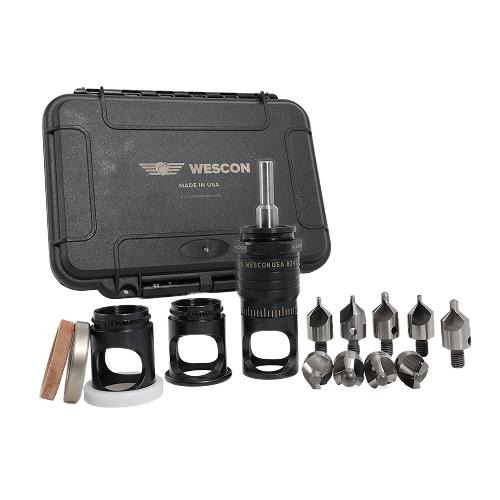 aircraft tools Wescon produces are made from aircraft-grade materials and machined to tight tolerances in their own facility. Because they control the entire manufacturing process internally, quality does not vary between production runs.
Understanding How the Microstop Works
The Microstop, sometimes called a countersink cage, is an attachment that fits onto a pneumatic drill or similar tool. It surrounds the cutter and limits how far the cutting edge can travel into the workpiece. Once the technician sets the depth using the micro-adjustment mechanism, that setting holds throughout the entire drilling session.
Wescon's Microstop units adjust in increments of 0.0005 inches. That level of precision is what makes them suitable for airframe work, where countersink depth tolerances are often specified to within a few thousandths of an inch. Getting this right matters because:
A countersink that is too shallow leaves the fastener head sitting above the surface, creating aerodynamic disruption and stress points
A countersink that is too deep reduces the bearing area of the fastener and can weaken the joint
Inconsistent depth across a panel creates uneven load distribution in the final assembly
The Microstop eliminates all of these variables by holding the exact depth setting the technician programs in before starting the run.
Wescon Microstop Series Overview
Wescon offers one of the most comprehensive Microstop catalogs in the industry, with over 3,300 products across multiple series. Each series is designed for a specific production scenario:
WES296 / WES297 - stub length units for close quarters work
WES396 / WES397 - compact units for tight space and small capacity applications
WES596 / WES597 - high speed heavy duty units for mainstream production
WES596-ER - extended reach units for recessed or hard-to-access work areas
WES596-EXA - extended adjustment units with 0.750-inch skirt adjustment for variable length cutters
WES598 / WES599 - swivel shaft units with 10-degree pivot for angled access
WES690 / WES696 - large capacity units handling cutter diameters up to 1.5 inches
Every series is available in both imperial and metric thread configurations, making Wescon's aircraft tools compatible with production lines anywhere in the world.
The Role of the Countersink Cage in Hole Quality
The Countersink Cage is the structural component of the Microstop that physically controls contact with the workpiece surface. It houses the cutter, the bearing assembly, and the foot piece, and it is the part that sits against the panel surface during the drilling operation.
Wescon engineers their Countersink Cage with integrated dust seals and high-precision spindles. The dust seals keep cutting debris away from the bearing surfaces, which extends the service life of the tool significantly in high-production environments. The precision spindles ensure the cutter runs with minimal wobble, which directly translates to cleaner, more consistent hole geometry.
The foot piece options available for Wescon's Countersink Cage units are another thoughtful engineering detail. Nylon and phenolic foot pieces are non-marring options that protect aircraft skins and composite panels from contact damage. Steel foot pieces are available for heavy-duty applications where the surface is more robust. Choosing the right foot piece for the material being worked keeps the finished panel surface clean and ready for assembly.
Custom Microstop Engineering for Special Applications
Standard catalog items cover the majority of production scenarios, but aircraft assembly sometimes throws up access challenges or cutter geometry requirements that fall outside what a standard tool can handle. Wescon addresses this by offering custom Microstop engineering directly through their production team.
Their engineering team can design and manufacture custom units with extended reach housings, unique skirt geometries, vacuum-adapted configurations, and tight-clearance footprints. Because this work is done in-house at their Texas facility, turnaround is faster than going through a third-party custom tooling shop, and the quality stays under Wescon's direct control throughout.
Fast Shipping Supports Production Timelines
Wescon ships same-day on all in-stock aircraft tools for orders placed before 12 PM CST. This applies to their standard Microstop catalog as well as other products in their range. They ship globally from their Houston facility, which means international facilities can access their tooling without the kind of extended lead times that typically come with specialty US manufacturing orders.
The cross-reference search tool on their website is also worth mentioning. If a facility is currently using Microstop units from another manufacturer and wants to switch to Wescon, the cross-reference tool makes it straightforward to identify the equivalent Wescon part without having to manually compare specs.
Conclusion
Aircraft tools like the Microstop are not glamorous pieces of equipment, but they are absolutely foundational to the quality of airframe assembly work. When they work correctly, everything downstream in the production process benefits. Wescon USA has spent over 40 years refining these tools, building them entirely in the United States, and backing them with fast shipping and responsive support. For facilities that depend on consistent countersink quality, their Microstop catalog is one of the most thorough and well-engineered options available anywhere.